
HPLC mobile phase
Aqueous channel for isocratic and gradient HPLC separations. Low UV absorbance and 0.2 µm filtration prevent baseline drift and column blockage.
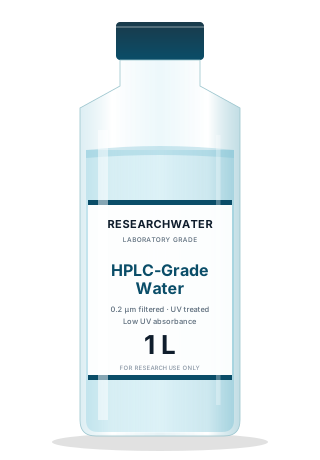
0.2 µm filtered, low-UV-absorbing water for HPLC mobile phases. Bottled in clear glass with PTFE-lined caps to prevent solvent contamination.
Aqueous channel for isocratic and gradient HPLC separations. Low UV absorbance and 0.2 µm filtration prevent baseline drift and column blockage.
Reliable baselines down to 210 nm support development of methods for compounds with low chromophore strength or short-wavelength detection.
Dilute samples for chromatographic analysis without introducing fluorescent or UV-active background that would obscure analyte peaks.
Final rinse for HPLC vials, syringes, and sample tubes to remove any residual surfactant or contaminant from the cleaning step.
UV cutoff is 190 nm, meaning UV absorbance is below 0.05 AU at 254 nm and below 0.5 AU at 200 nm. Across the typical HPLC detection range (210 – 254 nm) absorbance is well within the noise floor, so this water will not contribute spurious peaks or baseline drift.
Yes. The water is bottled in glass with PTFE-lined caps so it does not pick up plasticizers or surfactants that could interact with common HPLC additives like trifluoroacetic acid, formic acid, ammonium formate, or phosphate buffers. For ion-pairing or trace analysis, premix with the additive immediately before use.
HPLC-grade is filtered to 0.2 µm with low UV absorbance and is appropriate for UV/PDA/fluorescence detection. LC-MS grade adds sub-ppb specs on metals (Na, K, Ca, Mg) and lower volatile organics, since metal adducts and VOCs cause ion suppression on mass spec detectors. If you're running LC-MS or UHPLC-MS, choose the LC-MS grade.
Visit our Lab Results portal and enter the lot number printed on the bottle. You'll receive the full CofA — including resistivity, TOC, particulate count, and UV absorbance traces — as a downloadable PDF.