
Routine pH meter calibration
Daily, weekly, or per-shift two- or three-point pH meter calibration in research, QC, and analytical workflows. Color-coded bottles eliminate confusion at the bench.
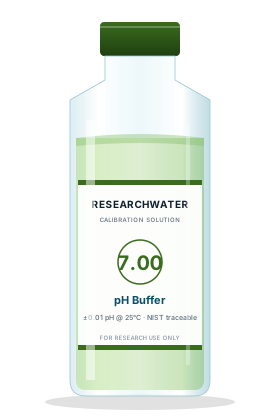
NIST-traceable, color-coded buffers for pH meter calibration. pH 4.00 (red), 7.00 (yellow), and 10.01 (blue). Each lot referenced to NIST standards within ±0.01 pH at 25 °C.
Daily, weekly, or per-shift two- or three-point pH meter calibration in research, QC, and analytical workflows. Color-coded bottles eliminate confusion at the bench.
Verify slope and offset on combination electrodes used for ORP measurement, helping detect drift, junction fouling, or electrode-end-of-life early.
Color-coded bottles and clear specifications make this kit appropriate for classroom and teaching lab use where students need an unambiguous calibration set.
Each lot ships with a Certificate of Analysis traceable to NIST standards, supporting GLP, GMP, and ISO-aligned QC documentation for buffer prep and media QC.
Each manufacturing lot is calibrated against pH reference standards whose values are themselves traceable to the National Institute of Standards and Technology. The Certificate of Analysis documents the chain of traceability and the measurement uncertainty.
Two-point calibration with pH 4.00 and 7.00 is sufficient for samples expected to fall in the acidic to neutral range. Use three-point calibration (4.00 / 7.00 / 10.01) when samples span the full pH range or when slope linearity above pH 7 matters for the application.
10.01 is the temperature-corrected value for the NIST-recognized borate buffer at 25 °C. This is the value listed on most laboratory pH meter calibration menus. The buffer itself is interchangeable with "pH 10.00" listings; the digit reflects measurement convention, not formulation difference.
For routine work, recap promptly and consume within 90 days of opening. The pH 10.01 buffer is most sensitive — atmospheric CO₂ absorption gradually reduces the reading. For trace work and GLP/GMP environments, follow your SOP-defined usage window or aliquot into smaller working bottles.