
Trace metal analysis
Sub-ppb heavy metal levels make this SKU appropriate for trace metal sample preparation where instrument blanks must remain near baseline.
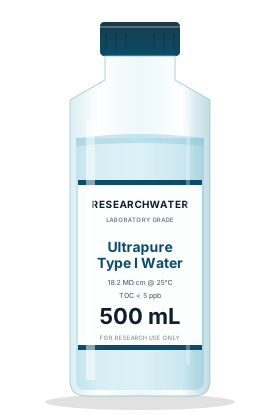
ASTM D1193 Type I — 18.2 MΩ·cm resistivity, TOC under 5 ppb. Polished by RO + EDI + 185 nm UV oxidation + 0.1 µm sterile filtration. A direct replacement for in-house Milli-Q output.
Sub-ppb heavy metal levels make this SKU appropriate for trace metal sample preparation where instrument blanks must remain near baseline.
Dilute samples and acid blanks with confidence on ICP-MS workflows where adventitious metals at the ppb level would compromise quantitation.
Prepare assay buffers, electrophoresis buffers, and chromatography buffers from a known-purity baseline so the buffer composition is the only variable.
Use as the diluent for qPCR master mixes and reagent dilutions where contaminating ions or organics would inhibit polymerase activity.
Yes. Each lot meets ASTM D1193 Type I specifications: 18.2 MΩ·cm resistivity at 25 °C, TOC under 5 ppb, conductivity under 0.056 µS/cm, and 0.1 µm sterile filtration. Functionally interchangeable with output from a properly maintained in-house Type I system.
Type I water absorbs CO₂ from air, which forms carbonic acid and decreases resistivity within minutes of exposure. For trace-sensitive applications, draw what you need and reseal. We recommend using opened bottles within 7 days for routine work and within 24 hours for trace metal or ion chromatography applications.
Type I (this SKU) is the highest grade — 18.2 MΩ·cm, TOC under 5 ppb. Type II is intermediate (≥1 MΩ·cm) and suited to general laboratory use. Type III is the lowest grade (≥0.05 MΩ·cm) and used for glassware rinsing or feed water for higher-grade systems.
Visit our Lab Results portal and enter the lot number printed on the bottle. You'll receive the full CofA — including resistivity, TOC, heavy metal results, and manufacturing date — as a downloadable PDF.