
PCR / qPCR / RT-PCR
Master mix preparation and template dilution for PCR, qPCR, and RT-PCR where trace nuclease activity would degrade templates, primers, or transcripts.
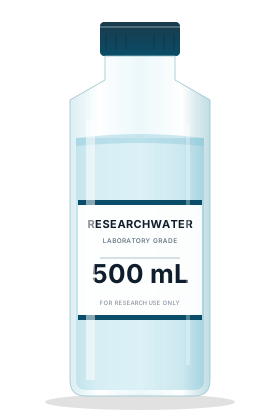
PCR-certified, nuclease-free aliquots for molecular biology. UV-treated, 0.1 µm filtered, autoclaved in dispensed container. Functionally tested for PCR and RT-PCR per lot.
Master mix preparation and template dilution for PCR, qPCR, and RT-PCR where trace nuclease activity would degrade templates, primers, or transcripts.
End-to-end use across NGS library construction — fragmentation, end-repair, ligation, bead washes — without introducing nuclease or endotoxin contamination.
Diluent for IVT reactions where RNase contamination at any level destroys transcript yield. Pre-aliquoted format eliminates cross-contamination from shared bottles.
Resuspend and dilute primers, oligos, and plasmid stocks for cloning workflows where DNA integrity drives downstream transformation efficiency.
No. We use a DEPC-treatment-free process: UV irradiation, 0.1 µm filtration, and terminal autoclaving in the dispensed container. Each lot is functionally tested for PCR and RT-PCR activity. DEPC treatment is unnecessary when the upstream process is validated nuclease-free.
Each manufacturing lot is run through a functional PCR and RT-PCR assay using known-yield templates. Lots that don't return target Ct values within spec are rejected. The CofA documents both the molecular biology specs and the functional release results.
If your workflow can tolerate the introduction of pipette-tip-borne nucleases between draws, the 500 mL bottle is fine. For RNA-sensitive work — IVT, RNA-seq library prep, single-cell — choose the pre-aliquoted 1.5 mL or 10 mL format to eliminate cross-contamination risk entirely.
Visit our Lab Results portal and enter the lot number printed on the container. You'll receive the full CofA — including PCR/RT-PCR release data, endotoxin, and nuclease activity assays — as a downloadable PDF.